Things were quiet in Goce after ringing in the New Year with friends. Running Man (RM) and I struggled to make ends meet. Every client dime I made went toward paying debt and in the dead of winter, RM had no tours to guide. We simply stayed home, bought a few groceries here and there when we needed them, and prayed the roof of the house didn't blow off during the burja winds and the chimney of our ancient, smoking stove didn't catch fire.
Our one splurge was going out for dinner on February 14. It was my birthday and Valentine's Day, so we scrimped and saved a few Euros so we could celebrate in very modest style. By late February, I started seeing signs of spring, which was incredibly early in the year for a girl from northern Missouri. First to emerge in our private little garden were zvoncki (zvaughnch-key) and trobentica (tro-ben-teetsuh), then crocus and daffodils, followed by tulips. They were all little gifts left behind by Anica, the previous owner who had loved and tended her garden with care for years.
Spring has always been my favorite time of year. As soon as snow melts, the earth starts to warm and days grow a bit longer, I start checking my planting beds, looking for tiny green shoots emerging from the cold soil. When I spot one, I carefully move old growth around the shoot and find myself filled with childlike wonder at the sight. For me, spring is an annual treasure hunt of joy.
Spring also makes me think of Easter, always a huge event in my family. Married siblings have to rotate Thanksgivings and Christmases, but there's never any competition for Easters, so everyone gathers at my parents' house. I had planned on being there for Easter this year, but wasn't sure when I would be able to afford to buy a ticket home. It was really a pretty dismal time for RM and for me. If we were stuck at the house, we would have liked to have been able to at least afford to start renovating. No, we were just stuck. Good thing it's a beautiful place because we weren't able to see much else.
In early March, RM had a call from an old friend who owned an inn outside of a tiny village in Croatia. RM had been wanting me to see the farm-turned-restaurant and to meet his friend who owned it. We decided to take his friend up on the invitation to visit and have a great meal, so one warm Sunday after Mass, we headed down to his place, not far from the border. Getting out and about was wonderful, and I was so ready for it. When we neared the border, I pulled our passports from my purse and handed them to RM. Croatia wasn't a member of the European Union, so you first stopped at the checkpoint on the Slovenian side, then proceeded through the checkpoint on the Croatian side. We'd done it several times before. But that day, we didn't get very far.
The Slovenian officer flipped through RM's passport, then mine. He inspected mine closely, turning pages back and forth and back again. This wasn't really uncommon. U.S. passports aren't something most of these officers see every day. He took my passport over to another officer, then returned, speaking to RM in Slovene, keeping the passports in his hand and backing away from the car. RM put the car into gear and started to pull forward and over to the side of the road. His face was grim.
"What's wrong?" I asked.
"He's asking me how long you've been here, and if you have a residence permit."
I breathed in sharply and a look of sheer horror spread across my face. I had been in the EU too long, and I was in trouble. The law is that unless you're a resident of the EU or have some sort of special visa to be there, you have to leave every 90 days during any six-month period. I knew that. I couldn't claim ignorance (which, as they say, isn't a defense anyway). I couldn't even claim that the thought hadn't ever crossed my mind during the past couple of months, but knew I didn't have the money to fly back to the States so I just put the thought out of my mind. Instead, I'd been focused on drumming up business in Slovenia so I could afford to go back. Sadly, my efforts hadn't panned out.
As RM told me to wait there while he spoke to the officers, my mind was racing. What happened now? Did they put me in jail? Haul me off to the U.S. Embassy in Ljubljana? Escort me to the U.S. Airforce base in Aviano, Italy, and put me on some cargo jet?
RM came back to the car, handed me our passports and buckled his seat belt.
"What happened? Where are we going now?" I asked hysterically.
"We're going back to Goce," he said, making a u-turn and pointing the car back north. "Fortunately for us, we had a very nice police officer who told me we need to turn around, go home and get you back to the U.S. as soon as possible. He also said that whatever we do, we don't want to cross the border into Croatia. They might not let you back out down there."
My shoulders sagged and I felt nauseous. RM tried to comfort me.
"He could have fined us," he said. "Instead, he gave us good advice."
"I need to go to the Embassy, " I said. "I need to find out what I should do. I am a criminal!"
"You're not a criminal," RM said.
"Yes, I am! I've broken the law. I could be persona non gratis and not even be allowed back in the EU for years!"
"Okay, now. Don't get so upset. We'll go to the Embassy in the morning and they'll help you," RM said calmly, trying to reassure me.
I was so angry with myself for not paying better attention to life in general. "What an idiot," I thought about myself. "Idiot" continued to resound through my head all night as I tossed and turned, waiting for morning to arrive.
We left early to make the hour-long drive into Ljubljana. I was quiet the entire way there -- always a sure sign of being either incredibly anxious about something or incredibly angry. I had visions of sitting down with the U.S. Ambassador to Slovenia and having him lecture me on the importance of international relations. I knew my law breaking wouldn't spark an international incident, but I did wonder about spending time in court or other sanctions, like being expelled from the country. I was also disappointed that my first visit to the Embassy was a dire stupidity emergency. That's precisely the good impression I wanted to make on the ambassador from my homeland, serving my adopted country.
I was rehearsing what I was going to say as we walked into the security area outside of the Embassy. There, Slovene security employees searched our persons and my purse, which they told me I needed to leave there with them. My mental rehearsal was interrupted by wondering why my Embassy wasn't guarded by U.S. Marines. Aren't Marines supposed to guard American soil abroad? I surmised that a tour of duty for a Marine in Slovenia might be a waste of a good soldier and started rehearsing my lines again.
When we walked through the front door of the Embassy, another Slovene security guard sat at a desk, barely looking up when we walked into the reception area. I asked to see someone about a visa issue. He pointed toward a door to our right and we walked in, then turned to face a wall of glass windows with little speaker grates like those that tellers use at some banks. There appeared to be only one person there, a woman who approached the window and asked, how she could help us. She, too, was Slovene. Where in the heck were my countrymen and women?
My voice was shaking, along with my hands, as I gave her the reason for our visit.
"I'm an American citizen and I own a house in Goce. I don't have a residence permit yet, and I've been here longer than 90 days. I need to know what to do."
The woman's eyes widened as she looked at me, leaned toward me from her side of the glass, then said slowly and in a loud whisper, "You have to leave," with an emphasis on the word,"leave."
"I understand that, but I need to know how to go about doing that," I replied.
She leaned toward me again.
"You have to leave now," she said, still wide-eyed and soft spoken, this time with the emphasis on the word, "now."
Ah, geez. I needed to talk to an American.
"Is there anyone else I can talk to here? Another American citizen, perhaps?" I asked, not wanting to insult her but needing some better advice than the painfully obvious.
"Please take a seat in that room to your left," was her noncommittal response.
RM and I sat down in a tiny room with four chairs and a small table and waited for what seemed like half an hour. My hope of seeing an American -- any American -- walk through the door was dashed when the same woman walked in, bearing sheets of paper in her hand. As she laid them down in front of me, I saw immediately they were copies of the Schengen Agreement of the EU countries. She proceeded to tell me the law regarding my stay, which I already knew.
"Yes, I understand the rules and that I am in violation of them," I said. "But I need to know what to do to get back to the States. I don't even have money to buy a plane ticket."
"But you've been here longer than 90 days, so you have to leave," was her reply.
I refrained from pulling hair -- mine and hers. I was really frustrated now, and extremely disappointed that when I needed my fellow Americans serving at the U.S. Embassy, they had left me with this very soft-spoken and kind but incredibly unhelpful Slovene citizen. Apparently, I was going to have to ask my question differently to stand a chance of getting some truly useful intel here.
"Okay, so I just buy a ticket and what happens when I get to the airport? Do they detain me when they see I've been here for too long?" Frustration was supplanting fear by now.
"They don't arrest you," she said. "You have to pay a fine."
Now, maybe we were getting somewhere.
"How much? I asked.
"Four-hundred Euros," she said.
"I can't even afford to buy a plane ticket, how can I pay 400 Euros?" I gasped.
"That's the same as I would have to pay if I stayed in another country too long," she said in the same soft, British English-inflected voice she'd maintained throughout our entire conversation.
Suddenly, I realized why so many people who break the law once are repeat offenders. They can't afford to get out of their life of crime!
"But if you pay them 200 Euros immediately, you can go ahead and leave the EU," she said.
I cocked my head and looked at her quizzically.
"So, if they catch me and I can't pay, I have to stay even longer until I can go to court and pay my fine and then leave," I said. "Or, I can hand them 200 Euros at the airport and that's that?"
I now had a shadowy mental image of crossing some passport control official's palm with cash and hoping he would take the bribe and let me leave Europe. The woman must have seen that vision playing through my mind.
"I could pay them 200 Euros immediately, same as you, same as anyone," she said. "This is official in the EU."
I slumped back in my chair, despondent over the amount of money I was going to somehow come up to get out of Europe and back to the States. I still felt like a criminal, but at least I knew what I had to do. And, fortunately, bribery wasn't involved so I wouldn't be compounding my sins.
We thanked the woman and left the embassy, gathering our items from the guards and making the drive back to Goce. I was relieved about knowing what to do but totally stressed about how to get it done.
RM and I had been working on a translation from Slovene to English for a company in Slovenia. We finished it the next day and emailed the invoice, telling them we needed payment right away. I got online to see what my airfare home would be. I couldn't just make the least expensive flight arrangements, which is typically what I do. RM and I developed a strategy for getting me home without incident, and that wouldn't necessarily be the least expensive way.
First, I needed a direct flight from Europe to the U.S. I couldn't risk having some passport control official in another country noticing that I'd overstayed my 90 days and holding me or fining me again for it. Once would be enough.
Second, I needed to choose carefully the airport I flew out of. Pick the right one and I might not have to hand over my on-the-spot fine. RM said the Slovenes would nitpick everything and would notice the problem. Same went for the meticulous character of airport officials in Austria and Germany. Nope. RM told me I needed to fly out of Italy where everyone -- including the officials -- were much more laid back and far less likely to notice my "issue." I searched for direct flights from Italy to the States and fortunately, Delta had one from Venice. Then, another thought entered my mind.
"What happens when the passport control officer in the States sees that I've been in the EU for longer than 90 days?" I questioned RM, as if he was the authority on the subject. "Will they detain me or fine me or something?"
RM chuckled. "Dah-ling, I don't think they care if you've been gone that long. But it's a good thing I haven't overstayed 90 days in the States and am trying to leave from there. Your passport people would definitely notice," he said.
Now, I had to figure out how to pay for my ticket. I scrounged together as much money as possible in my checking account in the U.S., invoicing two clients a few days earlier than usual and asking them if they could pay immediately. I was still short, so I emailed my good friend, J., and told her about the situation. She saved me again by immediately depositing the difference into my account. I booked my flight for the first week in April, packed my bag and continued to lay low. No matter what. I did not want to do anything that would require me to show anyone my passport.
During the two weeks before my flight, we pressured the Slovenian company to pay us. That took multiple attempts, but they did, probably blaming our relentless pursuit as "the American way." It was enough for me to have 200 Euros in cash and leave RM with a little money for gas and tolls to and from the airport.
It was a nervous farewell for me after I checked my bag and prepared to go through security for my flight. RM had been reassuring throughout this whole ordeal, but I knew I wouldn't be calm until I was on the plane. I kissed him goodbye and headed for security. I wouldn't be able to talk to him again until I landed in the States; my Slovene phone didn't work in Italy. I prayed that if something went wrong and I was detained, someone at the airport would let me call him.
The security checkpoint involved the usual undressing, scanning and re-dressing. Carry-on and passport wallet in hand, I started that long, dead man's walk to the international gates and toward the line of three Italian passport control officers, each seated in a glass box. I tried to not look suspicious as I approached them, which means I probably looked suspicious as hell or at least conspicuous. There were no long lines of people waiting so I couldn't count on mass confusion. It was pretty much just me and three fashionably dressed officials (yes, even law enforcement is stylish in Italy) on their thrones, waiting for me. I pulled my passport from my wallet and for the tenth time that day, counted the four 50 Euro bills inside. I took deep breath and headed toward Italian bachelor number two, smiled and handed him my passport and ticket.
"Buongiorno, signora," he said, looking me in the eyes.
"Buongiorno," I replied with the most relaxed smile I could muster under the circumstances. Gosh, how I wish I looked like some young American supermodel instead of a dumpy almost 50-year-old woman who probably smelled a bit like wood smoke, mud and by now, sweat. Flirtatious distraction would be a fabulous tool to use right now.
He looked at my ticket, then at my passport photo, then up at me and back down at my photo. He flipped randomly to one of the back pages, stamped it, then looked up at me again, smiling as he handed me back my passport and ticket.
"Grazie. Arrivederci," he said, quickly turning back to his conversation with the official in the next booth.
"Grazie," I replied, a massive smile breaking out on my face. RM had made the right call. Thanks to the laid back, casual qualities of Italians, I was on my way home and had a couple hundred Euros to send back to RM. My life of crime was over. It had been far too stressful for me.
I sat down at the gate to wait for my boarding call, feeling like a huge load had been lifted from my guilt-ridden shoulders.
"Note to self," I thought, as I settled in to wait. "Get your resident permit."
Note to my readers: I have enabled ads to be placed on my blog; however, I do not choose those ads. As I previewed this entry prior to publishing it, an ad appeared at the bottom of this blog post. The headline: Ever Been Arrested? Since I'm not sure that ad will continue to appear, I wanted to share the irony with you. :)
Showing posts with label Venice. Show all posts
Showing posts with label Venice. Show all posts
Thursday, April 25, 2013


Thursday, March 8, 2012
Homeward Bound
The Christmas Market in Traunstein was our second and last stop in Germany. Running Man (RM) had discovered this quaint little Bavarian village last summer on his trip from Slovenia back to France. It was a chance discovery; his car had broken down at the German-Austrian border and the nearest garage and hotel was in Traunstein. He was pleasantly stuck there for three days while his car was repaired and thought it was one place J. and I should see.
Traunstein is a well-preserved traditional Bavarian village with lovely little shops in the center, lining cobbled streets. Its biggest claim to fame is that the Pope attended seminary there before leaving for the university in Munich. The weather was damp but warm as we wandered from booth to booth at our second Christmas Market on our holiday tour.




Traunstein is a well-preserved traditional Bavarian village with lovely little shops in the center, lining cobbled streets. Its biggest claim to fame is that the Pope attended seminary there before leaving for the university in Munich. The weather was damp but warm as we wandered from booth to booth at our second Christmas Market on our holiday tour.

It didn't take us long to make our way to every booth at this market, including those serving gluwhein, of course. But J. and I also went into several of the regular shops, amazed by the fact that such a small village could have so many busy shops filled with beautiful clothing, home decor, dishes, crystal, jewelry and more. Mainstreet still thrives here. And as dusk started to fall, we had to stop for one last steaming mug of gluwhein and listen to the community ompah-pah band playing on a tiny wooden stage.

We weren't spending the night in Traunstein. RM had booked us into an inn near Lake Chiemsee a few kilometers away. When we awoke the next morning, snow blanketed the countryside, making it feel more like the Christmas season and putting us in the mood for more markets.

Today, we were headed for the alpine city of Mozart and The Sound of Music, Salzburg. From Lake Chiemsee, we had less than 20 miles to drive to Salzburg, just beyond the Austrian border. After a few rounds of singing "Eidelweiss," we were there, searching for our hotel in the city. RM had found one next to the year-round outdoor market and a few blocks from one of the bridges over the Salzach River, leading to the city center.
J. and I knew a bigger city meant a bigger Christmas Market and more booths. We couldn't wait to get going, so we checked into the hotel and dressed up for the cold. Alpine Salzburg was frigid and damp so we had to bring out our heaviest artillery. For me, that included a hat that tied around my chin and covered my ears. I'd bought it years ago when I'd been sent to Chicago for three months to work at my direct marketing agency's satellite office there. RM made a little fun of me when I put it on. J. told me to put some sort of pin on it to make it look better, and since I had brought some of my jewelry along on this trip to Sloevenia, I found a large vintage rhinestone brooch that I attached to it. As for J., she had a pointy suede hat lined with sheepskin. No wonder she didn't laugh too hard at my hat. We didn't care, as long as we were warm while trekking through Salzburg.
We set off down the busy street, first wandering through the farmer's market filled with fresh produce, meat, fish, even flowers. Suddenly, we all spied a booth filled with vegetables, including strange, large, pointed cabbages that stood like statues on the in the bins. We burst out laughing. It was a photo opp we couldn't pass up, and other people in the market couldn't help but at least smile.

The cabbage patch doll and I posed for one more picture, hats and all, before we crossed the bridge to the beautiful city center.

Salzburg's market was large and festive. We wandered through booths set up in courtyards and plazas, decked out with white lights and filled with music, food and, yes, gluwhein. We spent most of that day and all of the next day exploring the city center and finding a lot of treasures to buy -- things we hadn't seen at the other two markets. And as we'd done in Traunstein, J. and I wandered into some of the regular shops, drawn in by window displays of Christmas lights and decorations, Austrian crystal and magnificent traditional Bavarian clothing.

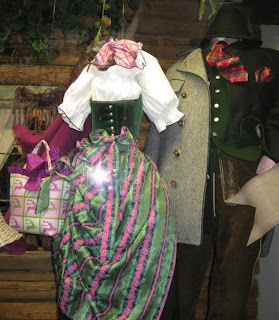
It wasn't cheap to dress in these traditional clothes. In fact, they were incredibly expensive. But since J. and I neither one thought we would ever have the appropriate opportunity to wear such an outfit, we were content with just admiring them.
RM had to do some rearranging in the car after our Salzburg stop. J. and I had accumulated several bags by now and we'd sort them out once we were back in Slovenia. We had two more stops to make, in Villach and Klagenfurt, Austria, just before we would cross the border into Slovenia. The last two markets were small but nice; however, by this time, we were seeing more of the same stuff for sale and I was just about gluwheined out. It was time to go home.
As we drove down through the alps, headed toward Goce, I became excited about being back home but a little nervous about our first house guest. The house had sat empty for days in the cold with no fire in the smoking stove and no electric heaters on. Nonetheless, I couldn't wait to show it off to J.
We stopped for groceries in Vipava before heading up to the village. It was dark when we arrived. I can't say that J. was impressed with the place, but once she'd warmed up next to the stove, which tended to belch smoke from time to time, she started to settle in to the middle room. RM had purchased a new twin bed while I was gone and had screwed wooden planks to the two walls around the bed to help warm up the cold stucco. That's where J. would sleep. The house warmed up, although RM kept having to replace fuses in the ancient box that kept blowing under the weight of having so many electrical appliances running at the same time.
What I didn't know was that J.'s expectations for the house were incredibly low. Of course, I'd been honest with her, telling her that other than cleaning it up, we hadn't done much to it. Her comment was straight and to the point: "It isn't nearly as bad as I thought it was going to be. In fact, it's kind of cozy."
We took a day to drive to Trieste. J. had been there before but we wanted to see if they had a Christmas Market. We never found one, but loved spending time in all of the shops in the city center. In fact, J. bought a beautiful and trendy red coat, her favorite color. We walked by it, displayed in the window of a small shop, a couple of times before my urging sent her through the door to try it on. Sold. I only wondered how she was going to get home with the lovely traditional Bavarian hat she'd purchased in Munich,a new coat and all of the Christmas Market treasures she'd bought along the way. Oh, and there were the dozen packages of gluwhein mix we'd discovered in Slovenia where it's called "kuhano vino." Just pour it into simmering wine, stir and enjoy!
We celebrated J.'s birthday with dinner at home as she worked to pack and repack, somehow making everything fit except for a stainless steel covered pan she'd bought in Slovenia. I wasn't surprised. J.'s a consummate traveler and extremely organized. As for the pan, I'd bring that back with me on my next trip.
It was time to leave for Venice. We parked the car in a garage and boarded the Tronchetto for the water ride into Venice. It was cold and gray and damp. And while we were shivering in St. Mark's Square, huge white flakes started to fall. It rarely snows in Venice. We were witnessing a bit of a miracle. It was my first time in the city built on stilts of Roman pine trees and I was in awe. Venice was magic under the snow.


I would have to come back when the weather was warmer to explore Venice. And since I now lived less than an hour away from it, that wouldn't be difficult.
We spent the night in a B&B outside Venice, near the airport. J.'s flight was early so we were up before dawn to end an incredible trip and resume our normal lives. I wondered what was normal for me now, living in this tiny Slovenian village so far away from Missouri. Perhaps "normal" would be synonymous with "adventure" for me from now, on. Everything, it seemed, was new.
Subscribe to:
Posts (Atom)